On the occasion of the Hungarian Science Day, the Year of Hungarian Science 2025-2026, and the founding of the Hungarian Academy of Sciences, the Consul General’s Residence in Edinburgh hosted the 3rd Conference of the Scottish-Hungarian Scholars Society on 14 November 2025. The host of this event, Consul General Dr. László Kálmán, welcomed all the participants.
After the welcoming remarks by the Scottish Co-President of the Society, Prof. Sir Iain Torrance (Professor, Vice-Chancellor the University of Aberdeen), Vice Presidents Dr. Ábrahám Kovács and Dr. Scott Spurlock reported on the Society’s activities over the past year. After the introductions of the new members, the participants discussed the Society’s future professional and cultural plans.
The guest of honour at the event was Dr. Ferenc Kumin, Ambassador to London, who briefly introduced the HUN-REN research network in his speech. He mentioned that HUN-REN is a multidisciplinary research network established to strengthen Hungarian scientific and innovation capacity. It will operate as an organisation with special legal status from 2025, and its funding will be secured through multi-year contracts with the government. This will increase autonomy and long-term stability. The aim of the reform is to make the network more dynamic, transparent and performance based; comparable to top European research models.
In total, around 30 people represented different scientific fields from the Scottish and Hungarian sides. In addition to Hungarian scientists, the event was attended by professors from Glasgow, Edinburgh, St Andrews, Aberdeen and other Scottish universities. All represented a wide range of disciplines in astronomy, nuclear physics, microbiology, space exploration, artificial intelligence, neuroscience, mathematics, ethnography, theology, history and political science.
The keynote speaker of the conference this time was Dr. Margaret A Mackay, Former Director of the School of Scottish Studies at the University of Edinburgh, who gave an illustrated presentation on her field work and other connections with Hungarian ethnologists which attracted great interest.
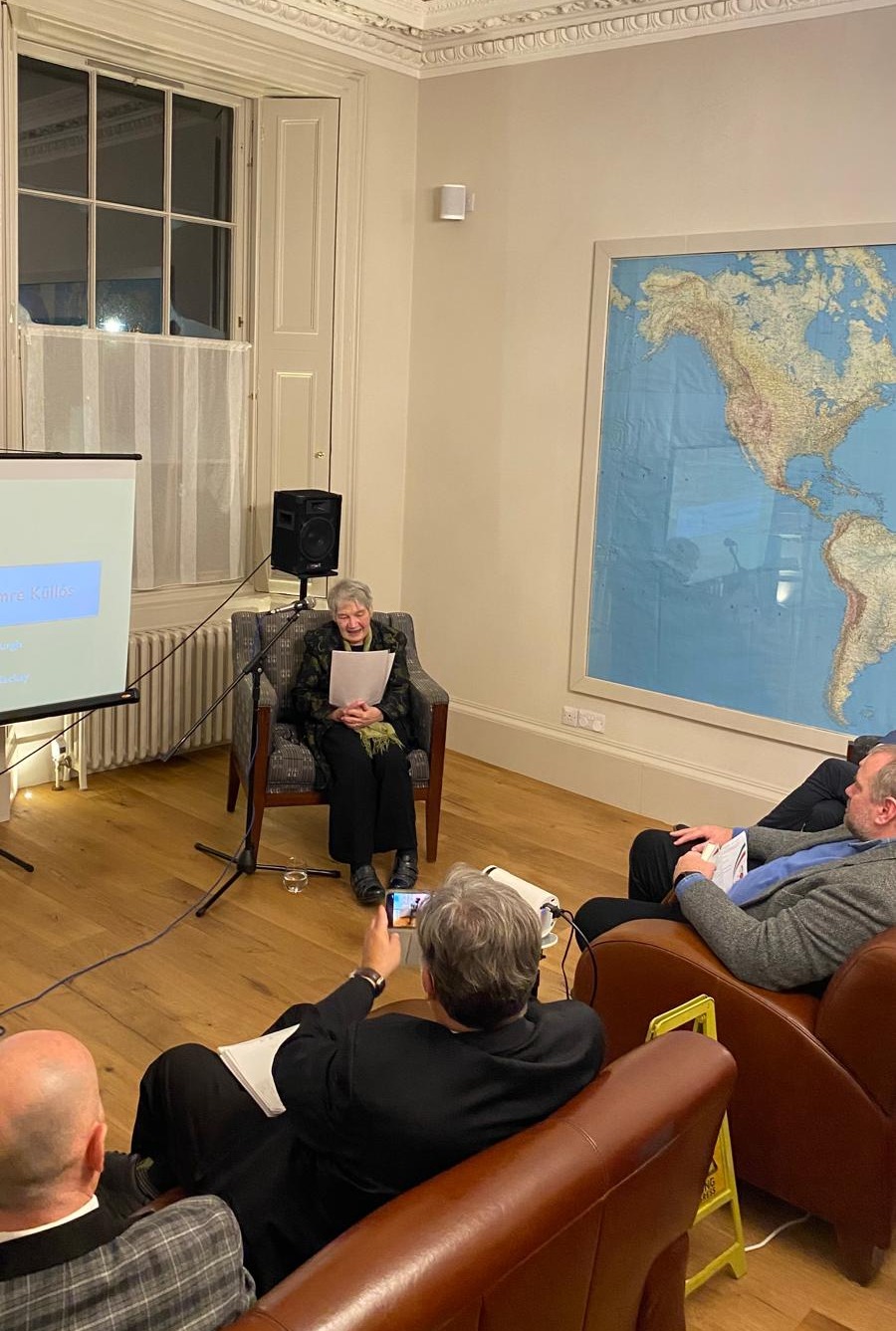
Dr. Margaret A. Mackay lecture
